


Sustainable movement – Public Transit as Climate Action
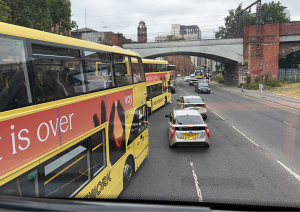
Step onto a busy street at rush hour and you will see the climate challenge in motion: long lines of cars, most carrying just one person, inching forward. Now imagine that same street with fewer cars and, instead, more buses moving steadily along, each carrying dozens of people. That shift is not hypothetical. It is one of the most practical and immediate ways to cut transportation emissions immediately. Whether you can make that change or not, it benefits us all.
The Math of Efficiency
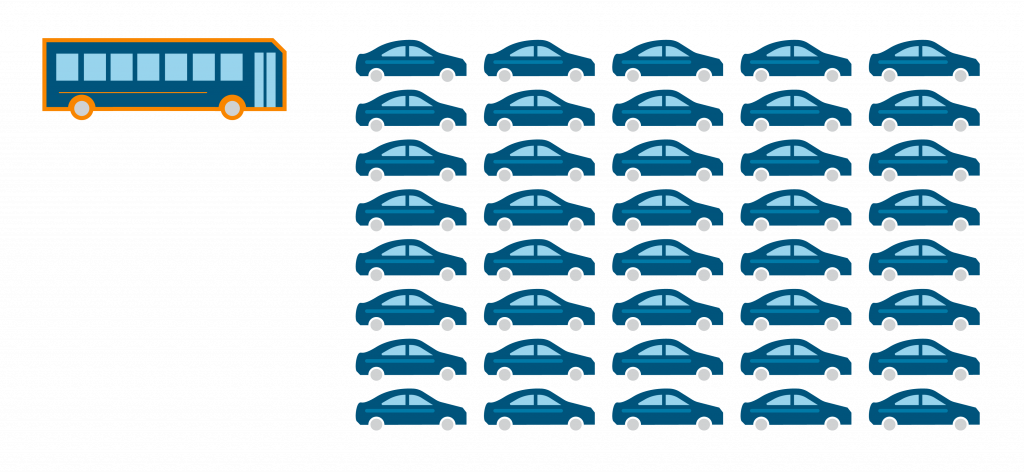
Transportation is a leading driver of global greenhouse gas emissions, and the math of the private vehicle is failing us. A single full bus can replace dozens of individual car trips. Even at half capacity, a bus is significantly more efficient per passenger than a standard sedan.
When cities invest in frequent, reliable bus service, a virtuous cycle begins: ridership grows, congestion eases, and the air becomes cleaner. These benefits compound when fleets transition to electric power. An electric bus doesn’t just reduce carbon, it eliminates tailpipe pollution entirely, providing immediate health relief to the urban communities it serves.
Evidence from Airparif confirms that modernizing transit fleets in Paris led to a 40% drop in nitrogen dioxide and a 30% reduction in fine particles between 2012 and 2022. This transition has provided immediate health relief to the urban population, with the number of residents exposed to air quality exceeding safety limits plummeting from nearly 500,000 in 2012 to almost zero by 2022.
Climate Action Without the Price Tag
Many climate solutions demand significant individual investment. Buying an EV and retrofitting a home for energy efficiency, such as installing solar panels, are vital steps, but they are constrained by income and property ownership. Transit is the great equalizer. A robust bus system with frequent service is a climate solution that people can join immediately. By reducing the necessity of car ownership, this doesn’t only cut carbon emissions, but also lowers the cost of living and expands access to healthcare, education, recreational amenities and jobs. It is climate policy that doubles as a social safety net.
Breaking the “Driving by Default” Habit
Public transit, and buses in particular, are one of the most immediate, scalable, and equitable tools we have to cut emissions. Yet, in America, this is often overlooked. In Europe and Asia, using public transit is a skill learned in childhood. In much of the United States however, driving is a reflex. Even in cities like Los Angeles, San Diego or San Francisco, where parking can cost $20 an hour and heavy traffic is a guarantee, many people still drive simply because they don’t have the experience of using public transit, which in many cases can be easy and comfortable, not to mention cheaper.
The “hassle” of the bus is often a myth. Consider the alternative:
- The Car: Navigation stress, traffic, responsibility for the safety of others and the endless hunt for parking.
- The Bus: Time to read, work or sleep; someone else is driving, and the freedom to jump on and jump off without worrying about parking or where you left your car.
Speed, Scale, and Flexibility
Bus improvements can happen fast:
- Dedicated Lanes: Can be painted and protected in months.
- Increased Frequency: Achieved through operational funding, although aided by piloting and marketing target services.
- Agile Routing: Buses can adapt to changing travel patterns and urban growth in near real-time.
Reframing the Narrative
The bus has often been framed as a fallback transportation mode for those without other options. That perception has affected policy decisions and funding. What if we reframed the bus for what it is? As essential climate infrastructure, as critical as a wind turbine or solar panels.
Next time a bus pulls up to your stop, see the forty cars it replaced. See the solution. It isn’t just an alternate ride option, it’s a pathway to a cooler, cleaner, and more connected world. Already in motion.
Want to work with us? Feeling inspired?
Contact us at info@dcrdesign.net or checkout our social medias: LinkedIn, X and Instagram